
Share this article
Quick summary
Here’s the essential info for the Mexico City Marathon 2026 at a glance:
| Race Date | Start Times | Start and Finish | How to Get There |
|---|---|---|---|
| Sunday, August 30, 2026 | 5:45 AM to 6:30 AM by block | Ciudad Universitaria to the Zócalo | Metro opens at 5:00 AM, free for runners |
Mexico City marathon map
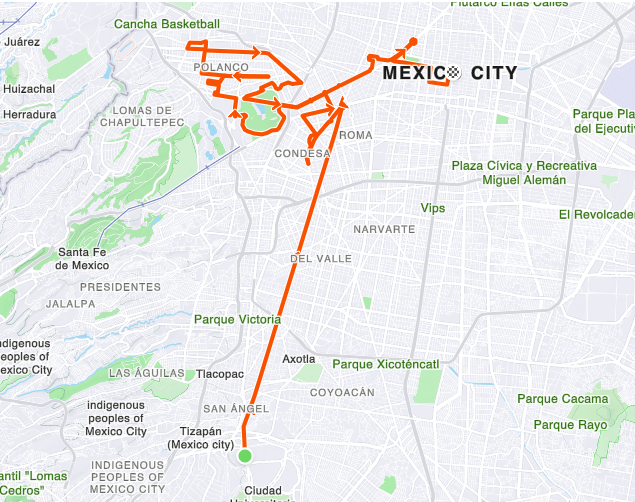
Here is the route for the Mexico City marathon (click to view the full map):
The Route: What Runners and Spectators Will See
The course starts on Avenida de los Insurgentes, between UNAM’s Biblioteca Central and the Estadio Olímpico Universitario, which is one of the more striking start lines in world running given that the campus is a UNESCO World Heritage site. From there the race runs north up Insurgentes Sur, passing Parque Hundido and the Glorieta de los Insurgentes before turning into Roma and Condesa, the two neighborhoods where the crowd support is loudest and where most visiting runners will recognize the streets.
From roughly kilometer 20 the route swings into Polanco, skirts the Bosque de Chapultepec, and picks up Paseo de la Reforma with the Ángel de la Independencia ahead on the avenue. The last stretch drops into the Centro Histórico past Bellas Artes and the Torre Latinoamericana, and finishes on the Plaza de la Constitución with the Metropolitan Cathedral and the National Palace framing the line.
One change for the 43rd edition: the finish has moved. In past years runners came into the Zócalo on the east side, effectively in front of the National Palace. For 2026 the field enters via Avenida 20 de Noviembre and crosses the line approaching the square from the south, which changes where spectators should stand for the final few hundred meters.
About the Mexico City Marathon
The race has been run since 1983 and this is its 43rd edition. It carries a World Athletics Gold Label, earned in 2018, which puts it in the same certification tier as the sport’s biggest city marathons and is why it consistently attracts a serious international elite field.
What makes it genuinely hard is not the profile but the air. The course sits at roughly 2,240 meters, about 7,350 feet above sea level, and the total climb is modest at around 65 meters. The pattern matters more than the number: the opening kilometers are flat, the section between kilometer 10 and 25 rolls, and the final ten kilometers tilt uphill right when the altitude has already taken its toll. Runners coming from sea level should expect to be several minutes slower than their usual time.
The course records stand at 2:08:23 for men, set by Héctor Garibay of Bolivia in 2023, and 2:25:05 for women, set by Ethiopia’s Amane Beriso in 2022. The race also has a well documented history of mass disqualifications for course cutting, including roughly 11,000 of 30,000 entrants in 2023, so timing mats and checkpoint enforcement are taken seriously here.
Race Day Schedule and Rules
The start is staggered across several blocks to move 30,000 runners off a single avenue, and the early flag-off is deliberate: it gets most of the field to the Zócalo before the sun gets high.
Start Times
- 5:45 AM: wheelchair and visually impaired athletes
- 5:50 AM: elite women
- 6:00 AM: elite men and Block A
- 6:15 AM: Block B
- 6:30 AM: Block C
Cutoff Time and Requirements
- Maximum finishing time of 6 hours, which works out to a pace no slower than 8:30 per kilometer
- A sweep vehicle follows the course and runners behind the cutoff are pulled from the route
- Minimum age is 18, and the timing chip is non-transferable and must be worn at chest height
- The full route must be completed and the finish line crossed, or the result is voided
Things to do after the Mexico City marathon
Where to Stay Near the Route
The route is unusually kind to visitors here, because it runs straight through the neighborhoods where most travelers already stay. Roma Norte and Condesa sit right on the course at around the halfway point, and Polanco is on it too, so you can walk out of your hotel and be at a good viewing spot in minutes. If you are running, staying in the Centro Histórico near the Zócalo puts you at the finish line and your bag drop rather than the start, which many runners prefer since the trip out to Ciudad Universitaria happens before dawn anyway. For recommendations on where to base yourself, check out our complete guide to Where to stay in Mexico City.
Take a look at the interactive map below and find accommodation close to the marathon route👇
Registration, Kits and Prize Money
Entry is capped at 30,000 runners. Online registration ran at $850 MXN early and $125 USD for foreign athletes, with entries open until August 26, 2026 or until the cap fills, whichever comes first. A limited number of in-person entries are sold at the Expo for $1,200 MXN, subject to availability, so if you are already in the city it is worth checking rather than assuming the race is closed.
Packet pickup happens at the Expo Maratón at the World Trade Center México, Salón Mexica, and there is no race day pickup:
- Thursday, August 27: 10:00 AM to 8:00 PM
- Friday, August 28: 10:00 AM to 8:00 PM
- Saturday, August 29: 8:00 AM to 4:00 PM
Bring official photo identification. Pickup is strictly personal, no one can collect on your behalf, and there are no name changes for any reason. The kit contains your race number with an integrated timing chip, the commemorative shirt, and a digital information passport. This year’s shirt is emerald green with a corn cob, ornamental flowers, and two feathered serpents, and the finisher medal features an axolotl, a feathered serpent, and a mirror at its center so each runner sees themselves in it.
On the prize side, the overall winners take $50,000 USD for first, $20,000 for second, and $10,000 for third, each with a Garmin watch. The first Mexican man and woman to place in the overall top three earn 200,000 pesos, and the top three Mexican finishers in each gender receive 50,000, 40,000, and 30,000 pesos.
Planning Your Race Day
Getting There
The Metro opens at 5:00 AM, two hours earlier than a normal Sunday, and runners ride free by showing their race number at the turnstile. For the start, Metro Universidad and Copilco on Line 3 are the closest stations to Ciudad Universitaria. For the finish, Metro Zócalo on Line 2 puts you at the plaza. The organizers also run six dedicated bus routes to the start, four of them from 3:00 AM and two from 3:30 AM.
Expect heavy road closures from before dawn until around midday along Insurgentes, Paseo de la Reforma, and throughout the Centro Histórico. If you are not involved in the race but have a flight, a tour, or a checkout that morning, build in a large buffer and assume rideshare will struggle to reach you. Walking is often faster than driving anywhere near the route on marathon morning.
What to Bring
Late August is the middle of Mexico City’s rainy season, and race morning typically starts cool at around 12 to 15°C, roughly 54 to 59°F, warming toward 22°C or 72°F by late morning, with a real chance of light rain. Bring a throwaway layer for the pre-dawn wait at the start, sun protection for the second half, and more hydration strategy than you would use at sea level. Spectators should plan for the same swing, since standing still at 6:00 AM is much colder than running.
Race Day Experience
This is one of the best big-city marathons to watch precisely because the route is walkable in segments. Parque México in Condesa catches runners mid-race with a strong neighborhood crowd, the Ángel de la Independencia on Reforma is the classic photo position, and the Zócalo finish fills up with families through the morning. Mariachi and neighborhood sound systems set up along the course, so the atmosphere is closer to a street festival than a sporting event. At the finish there are medical services, baggage collection, and recovery packages with fruit and hydration.
Explore Mexico City
For ideas on what to experience while you are in the capital beyond the marathon, read our article on Things to do in Mexico City. You can also explore our guide to Mexico City Neighborhoods to understand the different areas and find the perfect place to base yourself during your visit.
Frequently Asked Questions
What time does the Mexico City Marathon 2026 start?
Wheelchair and visually impaired athletes go at 5:45 AM, elite women at 5:50 AM, and elite men along with Block A at 6:00 AM, followed by Block B at 6:15 AM and Block C at 6:30 AM. Your block is printed on your race number.
What is the route of the Mexico City Marathon?
The 42.195 kilometer course starts on Avenida de los Insurgentes at Ciudad Universitaria, runs north up Insurgentes Sur through Roma and Condesa, enters Polanco and Chapultepec from around kilometer 20, follows Paseo de la Reforma past the Ángel de la Independencia, and finishes at the Zócalo, entering the plaza via Avenida 20 de Noviembre.
Is the Mexico City Marathon hard?
Yes. The course sits at roughly 2,240 meters or 7,350 feet, where there is meaningfully less oxygen than at sea level. The climbing itself is mild at about 65 meters total, but the last ten kilometers trend uphill, and most runners arriving from lower elevations finish several minutes slower than their usual marathon time.
Is Mexico City a major marathon?
No. Mexico City Marathon holds a Gold Label from World Athletics, which certifies high standards of organization and elite competition, but it is not one of the official Abbott World Marathon Majors.

Never miss what's happening in Mexico City!
Deals, travel tips & news direct to your inbox.